
Peter – From Failure to Restoration
Discover how Peter’s journey from failure to restoration reveals God’s grace, forgiveness, and purpose. Learn powerful lessons for overcoming failure and walking in restoration.
Written By Missionary Ps Javed Niamat
5/4/20263 min read
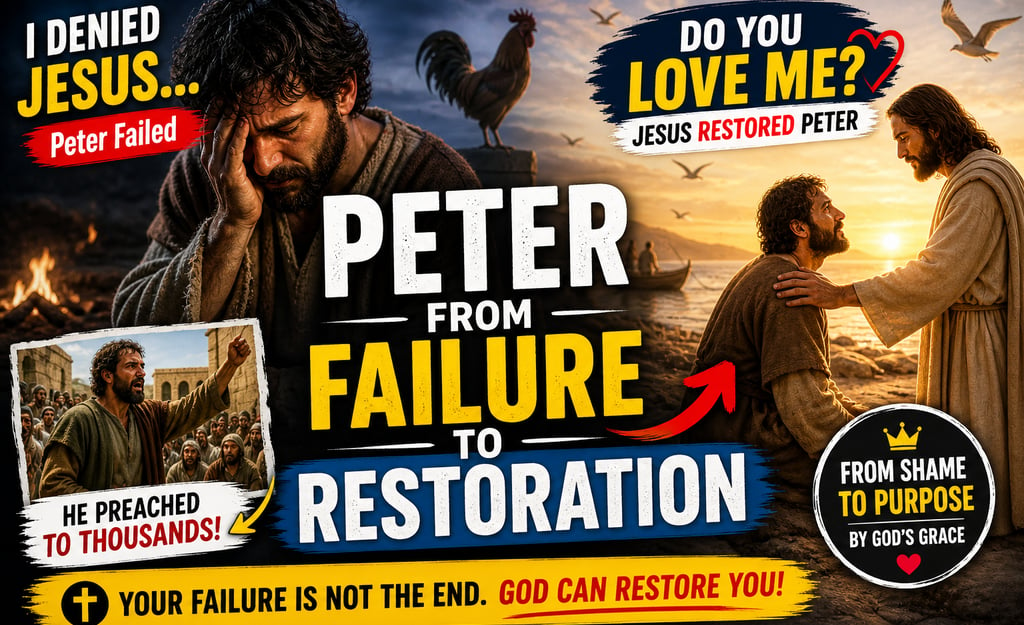
Peter – From Failure to Restoration
Introduction
Failure is something every human being experiences. No matter how strong, faithful, or committed we are, there are moments when we fall short. For many, failure brings guilt, shame, and a sense of disqualification.
But the story of Peter in the Bible offers a powerful truth: failure is not the end—restoration is always possible.
Peter, one of Jesus’ closest disciples, experienced a devastating failure when he denied knowing Jesus. Yet, his story did not end in shame. Instead, it became a testimony of grace, forgiveness, and divine restoration.
This article explores Peter’s journey from failure to restoration and what it means for our lives today.
1. Peter: A Man of Passion and Promise
Peter was not an ordinary disciple. He was bold, outspoken, and deeply devoted to Jesus.
He stepped out of the boat to walk on water (Matthew 14:29)
He declared Jesus as the Son of God (Matthew 16:16)
He promised unwavering loyalty: “Even if all fall away, I never will” (Matthew 26:33)
Peter had passion—but also impulsiveness.
Like many of us, his strengths were also his weaknesses.
2. The Moment of Failure: Peter Denies Jesus
Despite his bold declarations, Peter faced a moment that revealed his humanity.
On the night Jesus was arrested, Peter followed at a distance. When confronted by others, fear took over.
Three times, Peter denied knowing Jesus:
First denial: to a servant girl
Second denial: to another bystander
Third denial: with an oath, insisting he did not know Jesus
Then the rooster crowed.
At that moment, Peter remembered Jesus’ words—and the weight of his failure crushed him.
The Bible says he went out and wept bitterly (Matthew 26:75).
3. The Pain of Failure
Peter’s failure was not just a mistake—it was personal.
He didn’t just fail himself; he failed the One he loved most.
This reflects how failure often feels in our lives:
Regret over what we said or did
Shame that makes us want to hide
Fear that we’ve lost our purpose
Peter’s tears represent the deep sorrow that comes when we realize our weakness.
But here is the turning point: godly sorrow leads to transformation, not destruction.
4. Jesus Never Gave Up on Peter
Even after Peter’s failure, Jesus did not reject him.
After the resurrection, an angel gave a special message:
“Go, tell His disciples—and Peter…” (Mark 16:7)
Why mention Peter specifically?
Because Jesus knew Peter needed reassurance.
This shows us something powerful: God’s grace reaches us even in our lowest moments.
5. The Restoration: “Do You Love Me?”
Peter’s restoration took place by the Sea of Galilee (John 21).
Jesus asked Peter three times:
“Do you love Me?”
Each question mirrored Peter’s three denials.
With each response, Jesus restored him:
“Feed My lambs”
“Take care of My sheep”
“Feed My sheep”
This was not just forgiveness—it was reinstatement.
Peter was not only restored; he was recommissioned.
6. Restoration Includes Purpose
God does not just forgive—He restores with purpose.
After his restoration, Peter:
Preached boldly on the Day of Pentecost
Led thousands to Christ (Acts 2)
Became a foundational leader in the early church
The same Peter who denied Jesus became a fearless preacher of the Gospel.
This proves a powerful truth:
Your failure does not cancel your calling.
7. Lessons from Peter’s Journey
1. No One Is Above Failure
Even the strongest believers can fall. Stay humble and dependent on God.
2. Failure Is Not Final
Your mistakes do not define your future.
3. God’s Grace Is Greater Than Your Sin
No failure is beyond God’s ability to forgive.
4. True Repentance Leads to Restoration
Peter wept, repented, and returned—this opened the door to restoration.
5. God Restores with Greater Purpose
Often, God uses our failures to prepare us for greater impact.
8. How to Move from Failure to Restoration
If you feel like Peter—broken or disqualified—here are steps you can take:
1. Acknowledge Your Failure
Don’t hide or deny it. Be honest with God.
2. Repent Sincerely
Turn your heart back to God with genuine sorrow.
3. Receive God’s Forgiveness
Don’t stay stuck in guilt—accept His grace.
4. Reconnect with Jesus
Spend time in prayer, Word, and worship.
5. Step Back into Purpose
God still has a plan for your life.
9. From Brokenness to Boldness
Peter’s life shows a complete transformation:
From fear → to courage
From denial → to declaration
From failure → to faithfulness
This transformation is available to every believer.
God specializes in restoring broken lives.
10. Encouragement for Today
If you are carrying guilt or regret, remember:
You are not disqualified
You are not forgotten
You are not beyond restoration
Just like Peter, your story can change.
Failure may be part of your journey—but it is not your destination.
Conclusion
Peter’s story is a powerful reminder that God’s grace is bigger than our greatest failure.
Where there is repentance, there is restoration.
Where there is restoration, there is renewed purpose.
God did not abandon Peter—and He will not abandon you.
Your failure is not the end of your story.
With God, it can become the beginning of something greater.